From 2.6 Million MDRs to Actionable Insight: How AI Is Changing Post-Market Surveillance
.png)

The post-market data problem at scale
The numbers tell the story before the analysis begins.
In 2024 alone, manufacturers reported 2.6 million Medical Device Reports to the FDA. The agency issued 102 recalls. Individual manufacturers received millions of customer calls across their product portfolios. On top of that, data flows in from over 100,000 installed device platforms, scientific literature, clinical study results, and internal quality management systems.
Each of these data streams carries signals about product performance, patient safety, and emerging risk. But those signals are spread across systems that were not designed to talk to each other. Complaint data sits in the quality management system. Customer call logs sit in the CRM. Clinical data sits in a separate repository. Field performance data lives in the ERP. Scientific literature monitoring runs through its own tool.
The result is a surveillance operation that generates enormous amounts of data but struggles to extract timely meaning from it. Quality teams know the information is there. Getting to it fast enough to act on it is the problem.
Why data silos block product intelligence
The data silo problem in post-market surveillance is not just an IT inconvenience. It directly affects patient safety, product performance decisions, and regulatory compliance timelines.
When complaint data, risk files, clinical signals, and field performance data sit in separate systems, connecting them requires manual effort. A data analyst pulls a report from one system, cross-references it with another, builds a visualization, and delivers it to the business user days or weeks later. By the time the insight reaches the person who can act on it, the window for early intervention may have closed.
This model also creates a bottleneck at the analyst level. Business users (complaint handlers, quality engineers, regulatory specialists) depend on a small team of data analysts to generate every insight and every visualization. The analysts become the central point of access, and their capacity determines how much of the available data actually gets used.
One Smarteeva customer, a global leader in diagnostics and medical device manufacturing, described this exact challenge at the MedTech Forum in Lisbon. Their transformation strategy rests on four pillars: Insights, Data, Business Processes, and People. The goal is to move from a model where data analysts gatekeep insights to one where AI delivers embedded, real-time intelligence directly to the people executing the process.
The technical foundation for this shift is a data mesh architecture: a model where each business domain owns and manages its data as a product, with standardized interfaces that allow AI systems to query across domains in real time. When the data mesh is in place, an AI agent processing a complaint can simultaneously pull the relevant product risk file, check for similar historical cases, reference the customer’s device installation data, and flag any matching clinical signals. All within the same workflow, all without the complaint handler leaving their screen.
Real-time risk review: connecting R&D risk files to live complaints
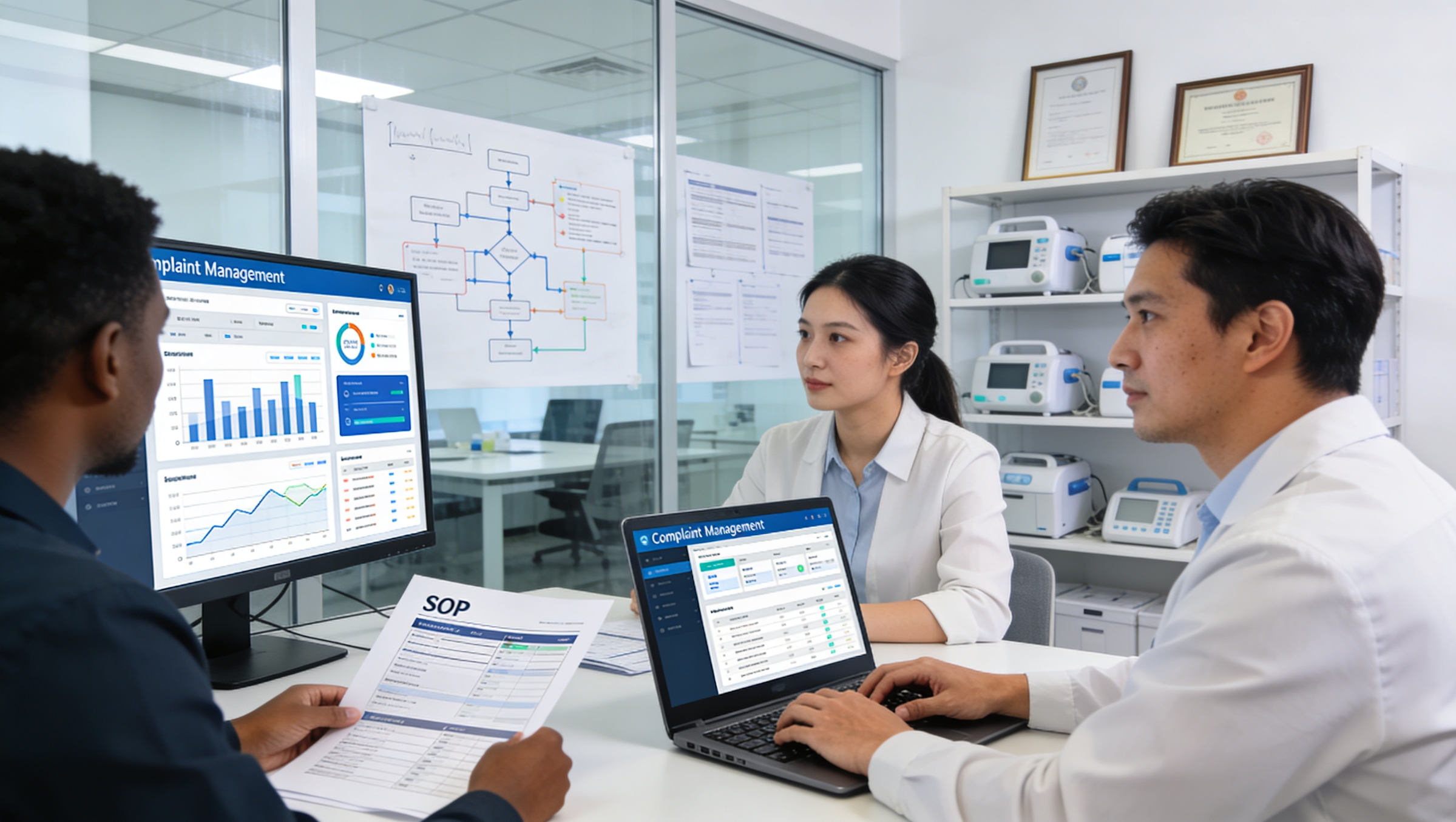
The first use case running on the Smarteeva platform connects two datasets that historically lived in separate worlds: R&D product risk files and post-market customer complaints.
In a traditional setup, the risk management team maintains risk files during product development. Once the device reaches the market, the post-market team handles incoming complaints. The connection between a specific complaint and a known risk in the R&D file requires someone to manually cross-reference the two, which happens inconsistently and often only during scheduled risk reviews.
With Smarteeva’s AI, that connection happens automatically at the point of complaint intake. When a new complaint arrives, the system evaluates it against the product’s existing risk file and returns one of two outcomes: it matches the complaint to a known risk and surfaces the relevant risk assessment, or it flags the complaint as a potential new risk that requires further evaluation.
This changes the timing of risk detection. Instead of discovering a connection between a complaint pattern and an R&D risk during a quarterly review, the quality team sees it on the same day the complaint is filed. Complaints are qualified, prioritized, and escalated based on risk severity from the moment they enter the system, not after a manual review cycle.