Is This Complaint Reportable? A Practical MDR Decision Guide Under 21 CFR 803

A medical device complaint is reportable to FDA as an MDR when the information you have reasonably suggests your device caused or contributed to a death or serious injury, or malfunctioned in a way that could cause or contribute to one if it happened again. Most reports are due within 30 calendar days of becoming aware.
Every complaint that reaches a quality team carries this question. Answer "no" when the answer is "yes," and you have a missed report that FDA can cite. Answer "yes" too often, and your team spends weeks on reports that never needed filing.
FDA also expects you to show your working. Under 21 CFR 803.18, your MDR event files must document how you decided whether an event was reportable, including the decisions where the answer was no.
This guide walks through the questions that decide reportability, the deadlines that follow, and a borderline case of the kind complaint handlers see every week.
The questions that decide whether a complaint is reportable
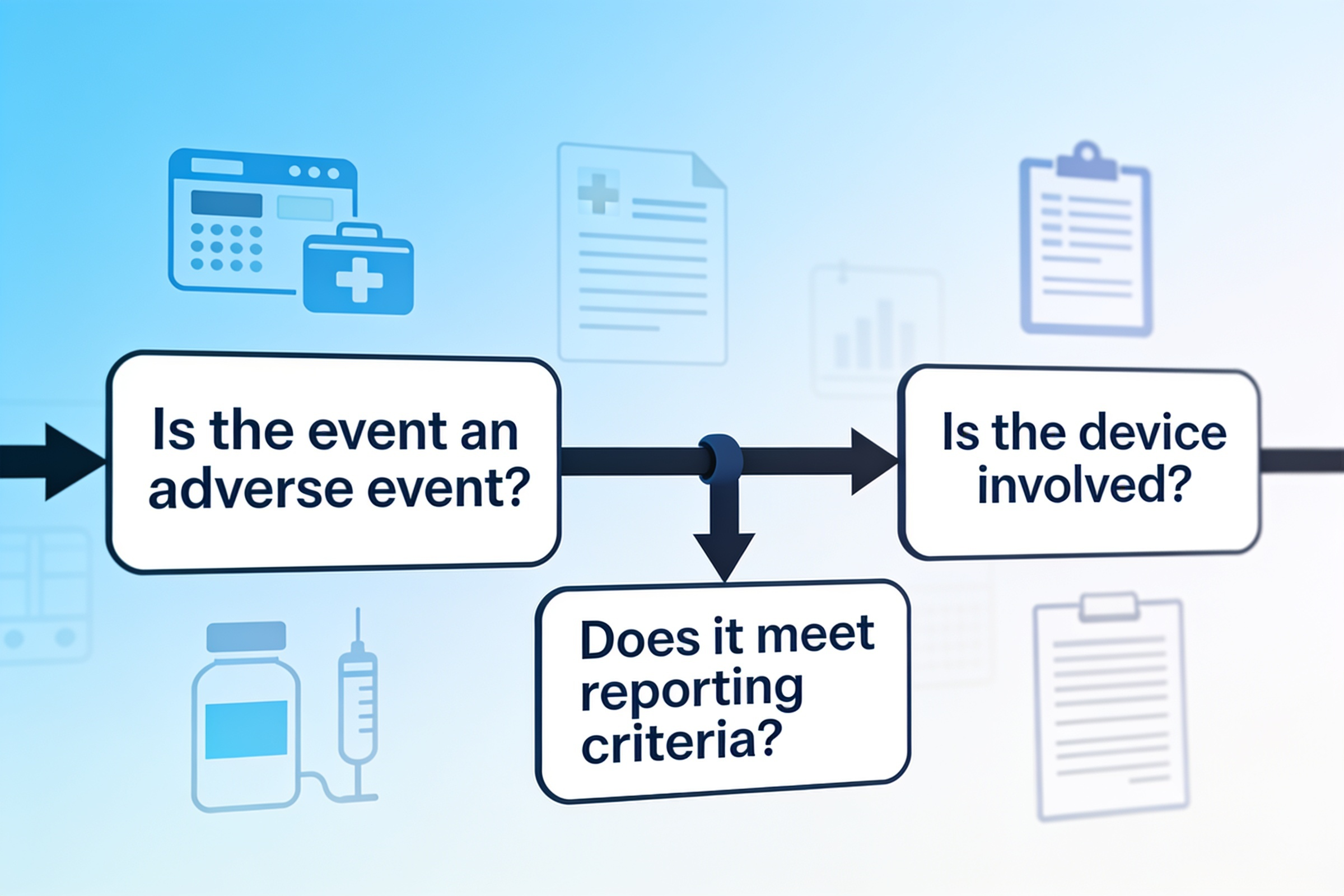
A sound MDR assessment asks the same questions in the same order for every complaint. These are the questions Smarteeva's MDR Decision Tree evaluates for a US FDA assessment, and they follow the logic of 21 CFR 803.
- Are you the manufacturer, or otherwise responsible for MDR reporting for this device? Manufacturers, importers and device user facilities each have different reporting duties under Part 803.
- Is the device subject to FDA MDR requirements? The device must be marketed in the United States, or be the same as or similar to one that is.
- Does the information reasonably suggest the device caused or contributed to a death or serious injury? A serious injury is life-threatening, causes permanent impairment or damage, or needs medical or surgical intervention to prevent permanent impairment.
- Was the event solely attributable to use error, with no device-related performance issue? If the device's design, labeling or instructions played any part, the event can still be reportable.
- Did a device malfunction occur? A malfunction is a failure of the device to meet its performance specifications or to perform as intended.
- If the malfunction recurred, could it cause or contribute to a death or serious injury? This question applies even when nobody was hurt this time.
- Is remedial action necessary to prevent an unreasonable risk of substantial harm to public health? A yes here triggers a 5-day report.
- Is there any other 5-day reporting requirement? FDA can also request 5-day reports for a specific device or event type in writing.
The answers produce two outputs: whether the event is reportable, and which deadline applies. Both belong on the complaint record, so anyone reviewing it later can see the path that led to the decision.
Four ideas that trip up complaint teams
1. No injury does not mean not reportable
The malfunction question catches events where nobody was harmed. If the same failure could contribute to a serious injury when it happens again, the event is reportable as a malfunction.
2. "Reasonably suggests" is a lower bar than proof
You don't need to confirm that the device caused the event before you report it. If the information you have reasonably suggests a link, the reporting clock is already running, and your investigation can continue alongside the report.
3. Use error rarely ends the assessment on its own
An event solely attributable to use error, with no device performance issue, may not be reportable. If unclear instructions, confusing controls or poor labeling contributed to that error, the device played a part.
4. The clock starts at awareness
For manufacturers, the deadline counts from the day any employee becomes aware of information that reasonably suggests a reportable event. A complaint that sits in a sales inbox for a week has already used a week of its 30 days.
30-day or 5-day: which MDR deadline applies?
Deadlines are where manual processes fail most often. A complaint that waits in an intake queue, or gets reassigned between investigators, can lose days before anyone starts the assessment.
A borderline case: no harm, but the wrong patient's images
Here is an anonymised example of the kind of complaint that needs careful handling.
The complaint: a healthcare user reports that images belonging to another patient appeared in the application's image thumbnails. No patient harm was reported.
A quick read might close this as a display glitch with no injury. Working through the decision questions shows why that would be premature.
- Was there a malfunction? The software showed one patient's images in another patient's record. That is a failure to perform as intended.
- Could it contribute to serious injury if it recurred? This depends on how clinicians use those images. If they could act on the wrong patient's images when making a diagnosis or treatment decision, the answer may well be yes.
- Do any other criteria apply? The team also checks whether remedial action is needed across the installed base, which would make it a 5-day report.
The absence of injury does not settle the question. The recurrence question decides it, and the answer rests on the device's intended use and the hazards already identified in its risk file.
This is also why the decision needs to be recorded in full. If FDA reviews the complaint file, it will look for the reasoning on the recurrence question as closely as the final answer.
How Smarteeva handles the reportability decision
Smarteeva evaluates reportability with a configurable MDR Decision Tree, using the facts captured on the complaint and its related records. Each quality team configures the tree to match its own MDR procedure.
- Rules make the decision. The reportability outcome comes from the configured decision-tree rules. An AI model does not decide on its own whether an event is reportable.
- AI handles the groundwork. Smarteeva's AI agents extract information from emails, forms and attachments, normalise the facts, and prepare the data that the decision tree evaluates.
- Every path is recorded. The questions answered, the path followed and the outcome reached all stay with the complaint, ready for an auditor or FDA inspector.
- Deadlines track themselves. A reportable outcome carries its reporting period, 30-day or 5-day. Smarteeva combines it with the awareness date to set the deadline, which then drives workflow status and regulatory work queues.
- A person signs off. The system prepares the regulatory record, and the right regulatory user reviews it and applies their eSignature before anything goes to FDA.
Once approved, the MDR goes from the same record to FDA through the ESG NextGen API, with each acknowledgement tracked on that record.
Where AI helps, and where rules decide
AI is good at reading a messy complaint email and pulling out the device, the event and the patient outcome. That saves complaint handlers hours of data entry on every case.
The reportability decision itself carries regulatory weight, so it needs to be explainable. A decision tree can show exactly which questions were answered and why the outcome followed, which is what an auditor asks to see.
Splitting the work this way gives teams the speed of AI on intake and a decision they can defend line by line.
Frequently asked questions
Is a device malfunction with no injury reportable to FDA?
Yes, if the malfunction would be likely to cause or contribute to a death or serious injury if it recurred. The absence of harm in this event does not make it non-reportable.
When does the 30-day MDR clock start?
It starts when any employee of the manufacturer becomes aware of information that reasonably suggests a reportable event. The date the complaint reaches the quality team is often later, so intake speed matters.
What is a 5-day MDR report?
A 5-day report is required when an event needs remedial action to prevent an unreasonable risk of substantial harm to public health, or when FDA has asked for 5-day reports in writing. It is due within 5 work days of awareness.
Do I need to document complaints that are not reportable?
Yes. Under 21 CFR 803.18, MDR event files must document the deliberations and decision-making used to decide whether an event was reportable, including decisions not to report.
Can AI decide whether a complaint is reportable?
In Smarteeva, AI prepares the data and configured decision-tree rules make the reportability decision, so every outcome can be traced. A regulatory user then reviews and signs the report before submission.
Get the MDR Reportability Decision Checklist
Download the checklist your complaint team can use on every case: the decision questions, deadline rules and the records FDA expects to see.