eMDR Submission Through FDA's ESG NextGen: A Practical Guide

eMDR Submission Through FDA's ESG NextGen: A Practical Guide
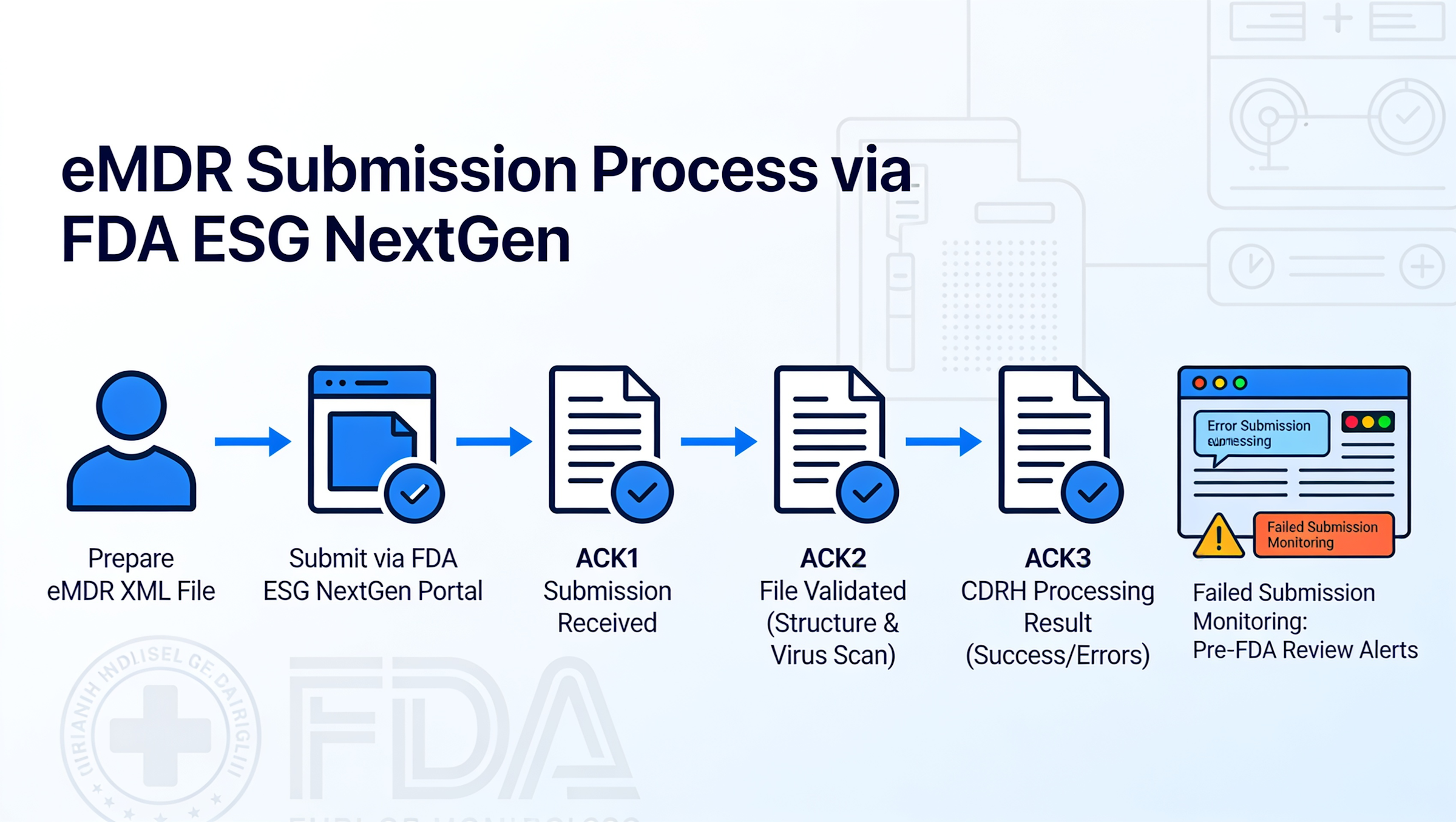
An eMDR is a Medical Device Report sent to FDA electronically through the Electronic Submissions Gateway. After you submit, FDA sends back acknowledgements: ACK1 confirms the gateway received the file, ACK2 confirms the device center received it, and ACK3 confirms whether the report loaded successfully or failed with errors.
Manufacturers and importers have had to submit MDRs electronically since 2015. Sending the file is the easy part; most of the work, and most of the risk, sits before submission and after it.
This guide covers what each stage of an eMDR looks like in practice, why submissions fail, and how to set up your process so problems surface before FDA sees them.
What ESG NextGen changed for submitting teams
FDA's Electronic Submissions Gateway Next Generation replaced the older gateway that companies used to send regulatory submissions. For device teams, the most useful change is that submissions can go through an API, straight from the system where the report is prepared.
In Smarteeva, that means an approved MDR goes from the complaint record to FDA through the ESG NextGen API. Each acknowledgement FDA returns is recorded against that same MDR, so nobody has to check a separate portal or match files by hand.
The eMDR lifecycle, stage by stage
A submitted file is only part of the picture. A regulatory team needs to know where every report stands until FDA has processed it. These are the stages an MDR moves through in Smarteeva.
The point of tracking each stage is visibility. Knowing a file was transmitted is different from knowing FDA accepted it, and only ACK3 tells you the second.
Why eMDR submissions fail
Submissions run into trouble when the report is assembled by hand at the end of the process. Someone copies details from the complaint, the investigation and the device file into a form, and a missing field or a mismatched value only shows up when FDA rejects it.
By then the clock is still running. A report rejected on day 28 of a 30-day window leaves very little time to fix it.
The fix is to structure the data from the start, so the report is built from information that has already been checked.
How Smarteeva stops failures before they reach FDA
- Required information is validated first. The workflow checks that the information FDA needs is present before the report can move to submission.
- The report is generated from controlled data. Smarteeva builds the submission from the complaint and regulatory data already on the record, instead of a form filled in from scratch.
- Failure reasons are kept. When ACK3 fails, the MDR returns to an open state with FDA's reason attached, so the team knows exactly what to correct.
- Technical failures stay separate from regulatory decisions. If a transmission fails for technical reasons, that does not change the underlying reportability decision. The team resubmits without reopening an assessment that was already made and signed.
That last point matters more than it first appears. A gateway error says nothing about whether the event was reportable, and the audit trail should make that clear.
What to check before you submit an eMDR
- The reportability decision is documented. The questions answered and the path followed are recorded on the complaint.
- The deadline is confirmed. The awareness date and the reporting period, 30-day or 5-day, are both on the record.
- Required fields are complete. Device, patient, event and manufacturer details match the source records.
- Event coding is consistent. Device problem and patient outcome codes match what the investigation found.
- The right person has signed. A regulatory user has reviewed the report and applied their eSignature.
Frequently asked questions
What is an eMDR?
An eMDR is a Medical Device Report submitted to FDA electronically through the Electronic Submissions Gateway. Manufacturers and importers must submit MDRs electronically.
What do ACK1, ACK2 and ACK3 mean?
ACK1 confirms the gateway received your submission, and ACK2 confirms FDA's device center received it. ACK3 tells you whether FDA processed the report successfully or found errors.
What happens if ACK3 fails?
FDA could not process the report, so it needs to be corrected and resubmitted. In Smarteeva, the MDR returns to an open state with the failure reason attached.
Can eMDRs be submitted straight from a complaint system?
Yes. ESG NextGen supports submission through an API, and Smarteeva submits approved MDRs to FDA from the complaint record.
Does a failed submission mean the MDR decision was wrong?
No. A technical or processing failure is a problem with the submission, and the reportability decision stands. Smarteeva keeps the two separate in the record.